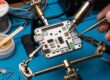

Few boards punish a careless copy like a motorcycle engine control unit. Riders expect instant cold starts, a steady idle in traffic, and clean power delivery at full throttle — all from a board that lives under a hot, vibrating, occasionally wet seat. When the original ECU is discontinued and the bike is otherwise perfect, the practical path is to copy motorcycle ECU printed circuit board units and rebuild a verified replacement. This guide walks hardware engineers and procurement teams through what that actually involves, from teardown to functional validation, and where the real risks sit.
What makes a motorcycle ECU board harder to copy than it looks
A motorcycle ECU is not a scaled-down car controller. The electrical environment is harsher in several ways that directly shape how you should reverse engineer the board. Start with power: the unit runs from a single 12 V lead-acid battery that collapses to 5–7 V during cranking and spikes to 40–80 V during alternator load-dump. A three-phase regulator-rectifier feeds it, so the supply rail is never as quiet as a bench supply. Any copied design must tolerate reverse polarity, double-battery jump starts, and sustained overvoltage without latch-up.
Signal integrity is the second trap. The crank and cam sensors are often variable-reluctance pickups delivering millivolt-level AC riding on a noisy harness, while Hall variants need clean pull-ups and debouncing. Ignition and injector drivers generate fast current edges that couple straight back into the analog front end. Get the grounding and the return paths wrong and the map becomes unstable only under load — the classic failure a bench test misses.
Electromagnetic compatibility is dominated by the ignition system itself. A coil-on-plug or wasted-spark arrangement throws tens of kilovolts and broadband noise every firing event, so the layout, shield, and filter strategy of the original matter enormously. Most markets expect compliance with CISPR 12 / ECE R10-style vehicle limits. Finally, the physical envelope demands ingress protection (commonly IP65–IP67), wide temperature operation, and vibration survival — and many units carry an immobilizer transponder coil whose crypto relationship to the ECU must be respected, not bypassed.
Teardown, imaging, and layer recovery
Most motorcycle ECUs are conformal-coated rather than fully potted, which makes preparation manageable but still mandatory. The coating must be removed selectively so you can read silkscreen, probe nets, and image traces without destroying fine-pitch pads. Blindly scraping or burning coating is how good boards get ruined.
Once bare, each copper layer is photographed and, for inner layers, exposed by controlled grinding and scanned individually. Motorcycle boards are usually 2–4 layers, but sport and injected models can reach 6. Micro-vias, plugged vias, and the main MCU — frequently a fine-pitch BGA or QFP — are checked with X-ray before any copper is removed, so hidden or buried connections are mapped rather than guessed. The goal at this stage is a complete, measurable layer set that can be vectorized into editable geometry.
Net extraction and component identification
With the layers imaged, the next job is turning pictures into a netlist. Power and ground are traced first, then the connector pins, then every net around the main controller. Component identification is where motorcycle ECUs get interesting. The MCU may be a legacy 8-/16-bit part or a modern 32-bit device such as a Renesas RH850, an Infineon TriCore, or an NXP S32K-class chip. Driver stages — injector and ignition — are often smart MOSFETs or dedicated gate drivers, and the analog section handles sensor conditioning for TPS, MAP, intake and coolant thermistors, narrow- or wideband lambda, and a piezoelectric knock sensor.
Unmarked, house-numbered, or laser-trimmed parts are common, and the immobilizer transponder interface (typically a 125 kHz RFID coil) sits on its own low-level path. Every device is identified by package, marking, and in-circuit behaviour; where a part is obsolete or unreadable, the candidate is flagged for approval rather than silently substituted. For a deeper look at the discipline, our automotive ECU reverse engineering service covers the same controller family across vehicles.
BOM reconstruction and schematic recovery
A faithful copy lives or dies on the bill of materials. Each component is matched to a currently procurable equivalent, with automotive-grade (AEC-Q) parts preferred where the original used them. Substitutions are listed and approved by you before assembly — never swapped silently. The recovered schematic is then drawn hierarchically: power tree, sensor conditioning, MCU periphery, driver stages, and any vehicle network, each annotated so a later engineer can actually service the board.
This is also where restoring a schematic from a physical board pays off. Calibration lives in firmware, but the hardware that holds the maps — external serial flash, EEPROM, or internal MCU memory — must be understood precisely, because the board and its program have to line up on one timeline if the clone is to run.
Prototype build and functional verification
A verified design package is only half the job. The cloned bare board is fabricated to the recovered stack-up, assembled with the approved BOM, and then functionally tested against the original module. On the bench we simulate a crank signal to exercise the VR/Hall input, drive injectors to confirm peak-and-hold current and dwell timing, fire the ignition stage, and close the lambda loop where the hardware supports it. The clone is compared point by point with the donor board so behaviour — not just continuity — is proven.
Firmware is the honest caveat. Where you are the lawful owner of the module and its software rights, the program can often be read and transferred so the new board runs identically. Modern security, such as RH850 debug lock or immobilizer crypto, may make that impossible, and a copied board without its firmware is an expensive paperweight. We state feasibility per device during assessment rather than promising a result. The same verification discipline applies to motor control board cloning elsewhere in the portfolio.
Common pitfalls when you copy motorcycle ECU printed circuit board hardware
The mistakes that sink these projects are predictable. The first is assuming the firmware will come along: a locked MCU or crypto-bound immobilizer means the hardware copy is only useful if you already hold the binary or a second unit. The second is ignoring the power rail — a clone that works on the bench but resets during cranking failed the load-dump and brown-out margin checks. The third is coating: aggressive removal damages pads and fine traces, so preparation must be methodical.
Connector pitch and keying are another quiet risk; motorcycle harnesses use tight, sometimes proprietary plugs, and a copy that does not seat is worthless. Thermal design is easy to underestimate — the regulator and driver stages sit in still air under a seat, and the original’s copper heatsinking and automotive PCB thermal management strategy must be reproduced, not approximated. Finally, calibration maps are not generic; a board rebuilt without the original timing and fuel tables will start but run poorly, which is why the program and the hardware are treated as one project.
Frequently asked questions
Is copying a motorcycle ECU board legal?
Yes, within a clear boundary. The work we perform is compliant reverse engineering and repair support for discontinued or legacy hardware that you own or are authorized to service. We require proof of ownership or a signed authorization before any project begins, and every engagement is covered by confidentiality. We do not bypass immobilizer security or reproduce devices for counterfeiting.
Can you recover the firmware as part of the copy?
Often, where the MCU is an older or lower-protection part and you hold the rights. Modern devices with active debug lock or secure boot may not be readable, and we will tell you that during the feasibility assessment rather than guessing. If a second, at least partially working unit exists, the binary can frequently be taken from it while the board data is recovered from the damaged sample.
How long does a motorcycle ECU copy take, and what does it cost?
A straightforward 2–4 layer board with an unprotected MCU typically runs one to three weeks including a tested prototype, depending on component lead times. Pricing follows layer count, board area, component density, and firmware protection level; you receive a fixed quote after a feasibility review, with engineering and per-unit build cost broken out separately.
Will the clone run exactly like the original?
Electrically and functionally, yes — same dimensions, mounting, connectors, and behaviour — provided the firmware is transferred or already held. Visual details such as silk-screen font or solder-mask shade may differ unless a cosmetic 1:1 match is specifically requested. Performance depends on carrying over the original calibration, which is why the program and board are handled together.
Do I need to send the original board?
Yes, the physical board is the source of truth. Clear photos of both sides are enough to start a feasibility and price assessment, but the actual copy, netlist verification, and prototype comparison require the unit. A second sample helps enormously when dealing with coating, corrosion, or firmware recovery.
To copy motorcycle ECU printed circuit board hardware properly, the work is less about redrawing copper and more about respecting a brutal electrical environment — a collapsing supply, ignition-driven EMI, wide temperature, and firmware that the hardware cannot run without. Done as compliant reverse engineering for legacy hardware, it keeps otherwise perfect bikes on the road and gives fleets a sane spares strategy. If you have a discontinued module, our PCB reverse engineering and cloning services can assess it, and you can request a fixed-quote assessment with two photos of the board. For the power-rail and EMC specifics, see our notes on vehicle PCB power integrity and PCB EMC design for reverse engineering.